


Umfundalai History
A Snapshot
C. Kemal Nance, PhD
Updated : April 27, 2026
The Umfundalai contemporary African dance technique emerges from the Black Arts Movement (1965-1975) as a result of Kariamu Welsh ‘s experimentation with continental African dance traditions, visual art and textiles, and African American social dance forms. A student and teacher of the Katherine Dunham technique, Welsh developed Umfundalai to tool her choreographies, to develop a movement practice that reflected her subjectivity as an African American woman. Welsh often described Umfundalai as “standing on the shoulders” of Dunham dance tradition. Umfundalai’s history technique is organized into six periods, the last of which reflects a current phase of development that has yet to be titled. Umfundalai’s historical periods include
-
The Buffalo Period
-
The Africa Period
-
The Philadelphia Period
-
The "Moving On" Period
-
The Post Progenitor Period
-
Current (Untitled)
The history begins with a singular trajectory congruent to the progenitor’s life and then splinters into Diasporic modality through which Umfundalai communities emerge in several locations throughout the United States and abroad.

The Buffalo Period (1970 - 1983)
“Have customers review you and share what they had to say. Click to edit and add their testimonial.”
-
1970 – Kariamu Welsh had a dream about a dance called Mfundalai and she choreographed a dance by that name; this was a seed that launched the evolution of a soon to be codified dance technique. Later, Welsh added ‘U’ to the spelling. During the 1970s Welsh worked, danced and studied with Chuck Davis (Chuck Davis Company), Pearl Primus (dancer, anthropologist, referred to as the “Mother of African dance” in the USA), and Pearl Reynolds (1st Generation dancer and teacher of the Katherine Dunham technique).
-
1971 to 1973 – Kariamu Welsh along with four other women opens “The School of Movement” at 11 E. Utica Street in Buffalo, New York where the technique was created and began its early stages of development.
-
1971 to 1979 – Kariamu Welsh changes the Black Dance Work Workshop (BDW) from a university club to a professional company in Buffalo, New York. (See Figure 2) BDW serves as the first professional demonstration company for the technique. In 1978, upon the encouragement and recommendation of Molefi K. Asante, Kariamu Welsh changes the company name from the Black Dance Workshop to Kariamu & Company.
The Africa Period (1980-1983)
-
1981 to 1983 - With support of a Fulbright Fellowship, Welsh moves to Zimbabwe in Southern Africa to study traditional dance. She becomes the first Artistic Director of the National Dance Company of Zimbabwe.
-
The Lapa (Wrappa) becomes standard studio attire for women in Umfundalai Class.
-
Live percussion becomes the preferred accompaniment for Umfundalai technique classes.
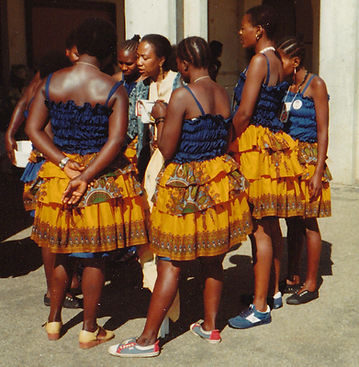

Photography: Patented Photos; Pictured (Left to Right): Glendola Xllyhema Mills, Makin Duewa, and Arica Brown.
The Philadelphia Period (1984-2014)
The Philadelphia Period encompasses several phases as it is the longest period of Umfundalai's history so far. It is largely characterized by Kariamu Welsh's tenure at Temple University during which her work with students at Freedom Theater and the University of the Arts made significant impacts on her artistic work and the development of the technique. Three doctoral dissertations about Umfundalai were successfully completed and defended in this period. Men begin to seriously study Umfundalai and the Umfundalai's reach as a viable Africanist philosophy takes root during the Philadelphia Period. This Philadelphia become the unofficial hub for Umfundalai activity.
1989 - Kariamu Welsh premieres her epic work, Raaahmonaaah!
1993 - Stafford C. Berry, Jr. and C. Kemal Nance become the first men to join Kariamu & Company.
1994 - The Umfundalai-based Seventh Principle Performance Company was formed.
1995 - Kariamu Welsh wins a Guggeheim Award
1995 - The first Umfundalai Intensive is held at Community Education Center and the Freedom Theater in Philadelphia, Pennsylvania
1995 - Glendola Xllyhema Mills completes and defense the first doctoral dissertation on Umfundalai
1996 - Glendola Xllyhema Mills becomes Umfundalai's first Dance Master.
1996 - Kariamu Company's title is amended to include Kariamu & Company: Traditions
2002 - C. Kemal Nance becomes a master teacher of Umfundalai.
2005 - Saleana Pettaway become Umfundalai's third master teacher.
The "Moving On" Period (2014-2021)
2016 - The first Umfundalai Master Teachers' Intensive is held at Temple University, Philadelphia, Pennsylvania.
2016 - Monique Walker becomes Umfundalai's fourth master teacher.
2016 - Formerly the Organization of Umfundalai Teachers, The National Association of American African Dance Teachers (NAAADT)becomes an official non-profit organization.
2018 - Kariamu Welsh relocates to Chapel Hill, North Carolina.
2018 - Kariamu Welsh retires from Temple University after 35 years of service.
2021 - The National Association of American African Dance Teachers airs the first virtual Umfundalai Teaching Ceremony.
2021 - C. Kemal Nance becomes Umfundalai's first Senior Master Teacher.
2021 - Kariamu Welsh transitions to the ancestral world.

Photography: Aaron Davis; Pictured ( Standing Left to Right): Glendola Xllyhema Mills, Kariamu Welsh, and C. Kemal Nance

Post-Progenitor Phase (2022- 2025)
2022 - Shaness Kemp and Cheryl Stevens become Umfundalai Master Teachers.
2022 - C. Kemal Nance starts the Uongozi Leadership Circle.
2024 - The Legacy Concert, a performance showcase of Welsh's work and burgeoning Umfundalai artists takes place at Temple University in Philadelphia, Pennsylvania.
Danzel Thompson-Stout becomes the first master teacher to trained certified beyond Kariamu Welsh's life.
Stafford C. Berry, Jr. starts the Umfundalai Council of Elders.

Photography: Aeria Charles
Current Phase (2026 - Present)
A Umfundalai Bibliography
Nance, C. Kemal. "Friction: Male Identity and Representation in Umfundalai." Dance and the Quality of Life. Cham: Springer, 2019.